Why Integral Coaching?
A bit of a jumper. That’s what my friends and family would say. When something feels right, I leap. And I go all in.
I can see why it looks like this from the outside. But what others don’t see are the hours of “mulling” – of feeling, reflecting, considering, researching, and living within the threads of uncertainty and transition. Those often happen quietly, internally.
And that’s what landed for me when I came across Integral Coaching. A methodology that not only holds, but actively works with complexity, with layers, with multiple lenses on an experience. It felt like a mirror image of my personal process. A natural fit.
There were other signals, too. I had raised my children within a few hundred metres of an internationally recognised, accredited and highly regarded training provider, Integral Africa Institute/The Coaching Centre. I also knew a few alumni doing wonderful work with its methodology. And, most importantly, African wisdom traditions had found their way into the training curriculum – which, given my work with local wisdom keepers as co-founder of Earthskills Africa, and my lifelong interest in Indigenous lifeways, felt like a clear sign that this was a training pathway worth pursuing.
But what is Integral Coaching? What are its roots and how does it express itself in the coaching world today – and in your world, perhaps?
The word “integral” comes from the Latin word “integer”, which means whole, entire, complete or, translated literally, untouched. In contemporary language, that best matches systems theory, which works not only with parts, but with the whole.

In fact, Integral Coaching can be viewed as something of a synthesis of adult development theory, systems thinking, humanistic and transpersonal psychology, and Ken Wilber’s Integral Theory (particularly the AQAL model – all quadrants, all lines).
Its methodology leans on multi-perspective exploration, taking into account the developmental orientation of the client as well as somatic and self-observation practices towards building new capacities, and asks that the coaches themselves engage in continuous self-development, working through blind spots and shadows to better support deep transformation in others.
In short, it is rigorous, but deeply human.
A compassionate, all-seeing ally in navigating complexity and change in living systems.
Which feels, to me, like a good fit for the times we are living in.
At Integral Africa/The Coaching Centre, our 14-month training spanned health, the enneagram, and asked that we develop a basic working model for assessment.
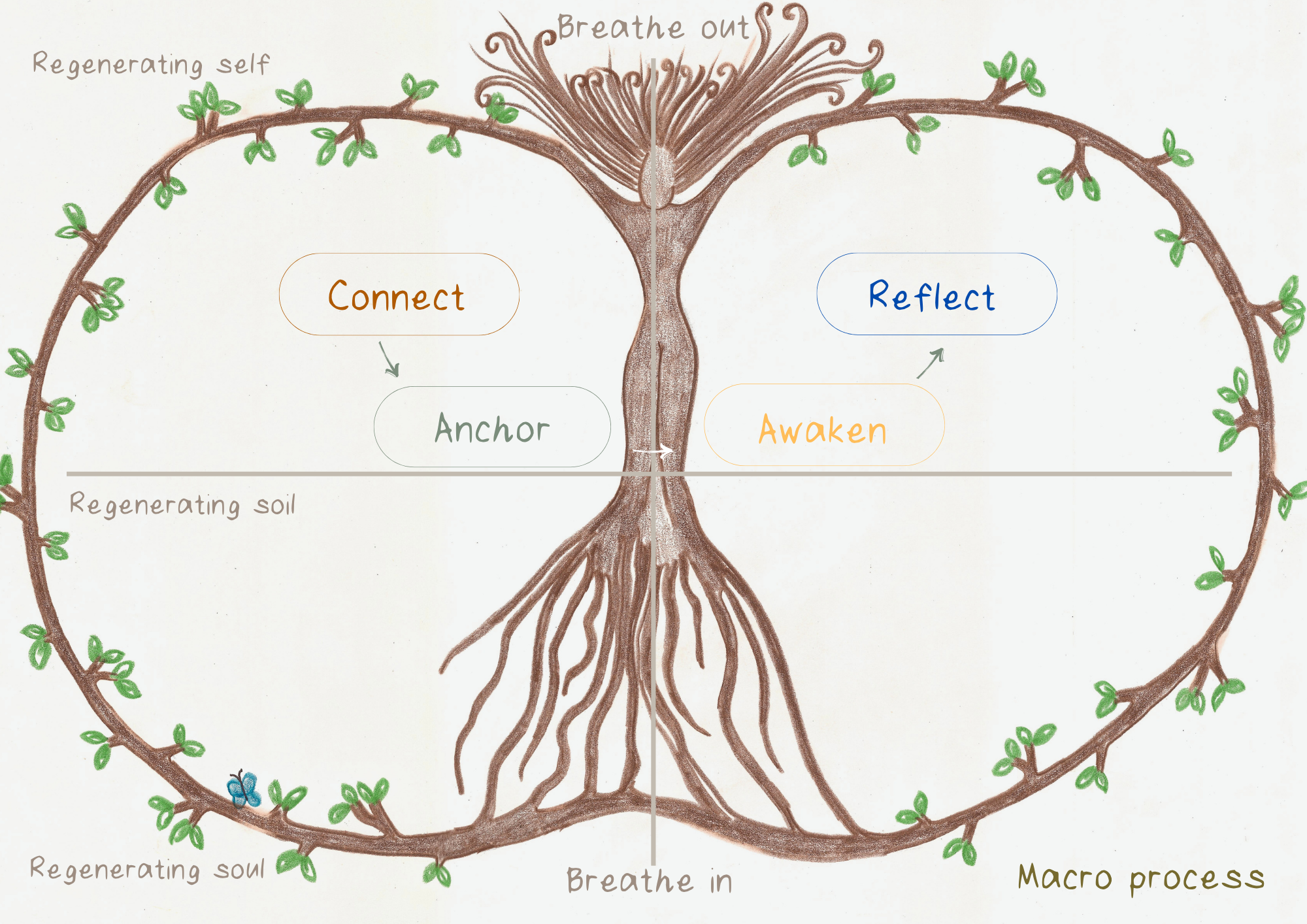
My supporting diagram looked like this (and has thankfully evolved since!) …
(This illustrates something of my emerging approach to this work, which takes into consideration not only the integral self, but the relational and ecological self as well.)
I’ve shared some of the reasons why I chose Integral Coaching as my root practice. But why would I recommend it for you?
In coaching circles, and in circles that make use of coaching as a support system, Integral Coaching is a respected and growing approach. People seek it out for specialised, holistic support, whether for personal growth, leadership development or the complexity of an organisation in transition.
Whether the focus of our time together is work, family, health, purpose or eco-engagement, Integral Coaching invites you to work not only with the parts of life that feel stuck, but with the ways in which these parts impact your life (or systems) as a whole.
So, why Integral Coaching?
Because you get to bring all of you into the coaching space and relationship.
Your whole self.
Your integral self.
To find out more, feel free to reach out for a no-obligation conversation.
With warmth,
Lu